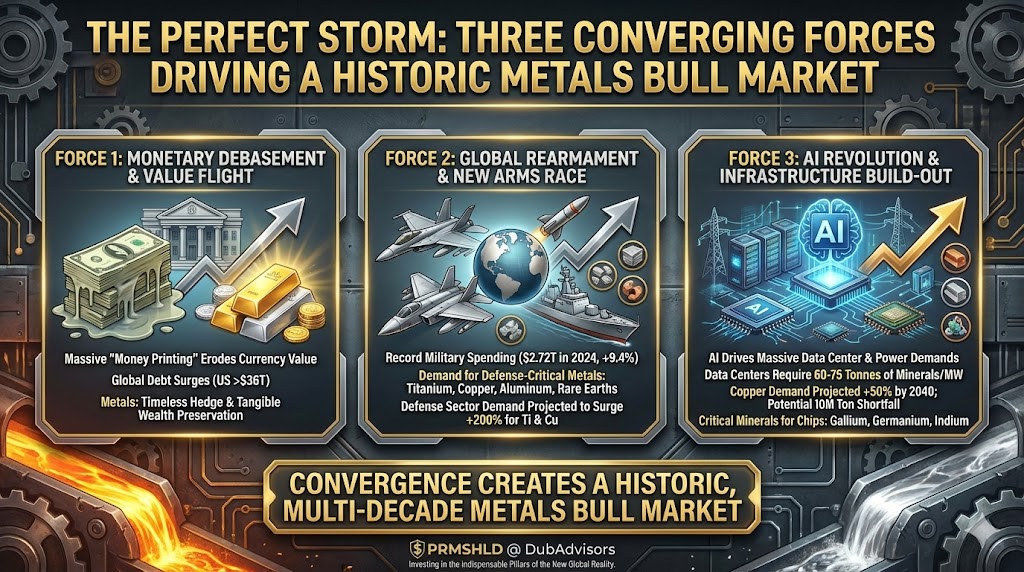
The Perfect Storm: Three Converging Forces Driving a Historic Metals Bull Market
In the world of investment, it is rare for a single, clear thesis to emerge from the noise of global markets. Today, we stand at such a juncture. My portfolio, $PRMSHLD @ DubAdvisors, is currently significantly weighted towards metals, a decision grounded in the powerful convergence of three distinct, yet interconnected, global forces. These are not fleeting trends but deep, structural shifts in our economic, geopolitical, and technological landscapes: the systemic debasement of fiat currencies, a worldwide surge in defense production, and the explosive infrastructural demands of the Artificial Intelligence revolution. This article will unpack these three pillars, illustrating why metals represent one of the most compelling and rational investment opportunities of our time.
Force 1: The Great Debasement and the Flight to Tangible Value
The foundation of our modern financial system is built on fiat currency—money that is not backed by a physical commodity but by the trust and credit of the government that issues it. For decades, this system has been under increasing strain, and we are now witnessing an unprecedented acceleration in its erosion. Central banks around the world, led by the U.S. Federal Reserve, have engaged in a multi-decade experiment of massive monetary expansion.
Since the 2008 financial crisis, the balance sheets of major central banks have ballooned. The U.S. Federal Reserve’s balance sheet, for instance, swelled from under $1 trillion in 2008 to over $6.89 trillion by 2024 [1]. The European Central Bank, Bank of Japan, and others have followed similar trajectories. This vast creation of new money, often referred to as “money printing,” directly dilutes the value of each existing currency unit, a process known as debasement. The U.S. M2 money supply has grown exponentially, adding trillions to the system and steadily eroding the purchasing power of the dollar [1].
Compounding this issue is the staggering level of government debt. In the United States, government debt is approaching 100% of GDP, a level not seen since the end of World War II. The Congressional Budget Office projects this could soar to 181% within 30 years [1]. To manage this unsustainable burden, governments have a hidden incentive to foster inflation, as it reduces the real value of their outstanding debt. As one financial analysis puts it, "Governments prefer inflation: it reduces government debt, lowers the debt ratio, supports the financial system, and creates opportunities for more tax revenue" [1].
In this environment, rational investors seek refuge in assets that cannot be created out of thin air. Metals, both precious (like gold and silver) and industrial, serve as a timeless store of value. Their finite supply and intrinsic utility provide a durable hedge against the relentless devaluation of paper currencies. The flight from fiat is not a matter of if, but when, and metals stand to be a primary beneficiary.
Force 2: The New Arms Race and the Materials of Modern Warfare
A profound shift in the geopolitical landscape is underway, triggering a global rearmament cycle on a scale not witnessed in decades. World military expenditure surged by 9.4% in 2024 to a record $2.72 trillion, the steepest year-on-year increase since the end of the Cold War [2]. This is not a localized phenomenon; spending is rising across every region as nations re-evaluate their security posture in an increasingly unstable world.
This surge is creating a powerful and inelastic demand for a specific set of raw materials. Modern defense systems—from fighter jets and hypersonic missiles to naval vessels and sophisticated electronics—are incredibly metal-intensive. The list of defense-critical minerals is extensive, including titanium, copper, aluminum, rare earth elements, gallium, and tantalum [3].
The numbers are stark. The Payne Institute projects that the defense sector's needs could lead to a 200% increase in demand for titanium and copper and a 250% jump for manganese and vanadium [4]. Titanium is so crucial that it is often called a “defense metal,” with military applications accounting for 20% or more of its total consumption [5]. Similarly, copper’s unmatched conductivity makes it indispensable for the advanced wiring, radar, and guidance systems at the heart of modern military technology [3].
This is not a cyclical trend tied to a single conflict but a structural re-basing of global security priorities. As nations from Europe to the Asia-Pacific reinvest in their military capabilities, they are locking in a massive, long-term demand for the fundamental building blocks of defense. This creates a powerful, non-discretionary tailwind for a broad basket of industrial and strategic metals.
Force 3: Building the Global Brain—AI’s Insatiable Appetite for Metals
The third force, and perhaps the most explosive, is the build-out of the physical infrastructure required for the Artificial Intelligence revolution. AI is not just software; it is a voracious consumer of energy and hardware, all of which is built from metal. In 2025, an estimated half of all U.S. GDP growth was attributed to AI spending, primarily on the computer chips, data centers, and power systems that form its backbone [7].
Data centers are the factories of the 21st century, and their construction is driving a new wave of metals demand. Each megawatt (MW) of data center capacity requires between 60 and 75 tonnes of minerals, with copper and aluminum being primary components [8]. Microsoft’s 80 MW data center in Chicago, for example, used approximately 2,100 tonnes of copper [8]. With data center capacity projected to nearly double by 2030, the demand for these metals is set to skyrocket.
Copper, in particular, is emerging as a major bottleneck. S&P Global projects that total copper demand will surge by 50% to 42 million metric tons by 2040, driven by electrification and AI. Their analysis warns of a potential 10 million metric ton supply shortfall within the next 15 years [7]. This structural deficit is forming just as AI demand hits its inflection point.
Furthermore, the advanced semiconductor chips that power AI are dependent on a host of rare and strategic minerals, including gallium, germanium, indium, and tantalum [9]. The supply chains for these materials are highly concentrated, with China controlling 98% of global gallium production and 60% of germanium refining [9]. This geopolitical concentration adds another layer of risk and upward price pressure. As the AI arms race intensifies, the competition for these essential ingredients will only grow more fierce.
Conclusion: A Portfolio for the New Reality
The convergence of these three powerful forces—monetary debasement, military rearmament, and the AI infrastructure build-out—creates a perfect storm for metals. Each force alone would be a significant driver of demand; together, they form a historic, multi-decade tailwind that is unlikely to abate.
While other asset classes are vulnerable to the whims of central bank policy or the volatility of digital trends, metals are grounded in the physical realities of our world. They are the essential materials for preserving wealth, ensuring national security, and building the future of technology. This is the clear and compelling logic behind my $PRMSHLD portfolio's strategic weighting towards metals. I am not merely speculating on a commodity; I am investing in the indispensable pillars of the new global reality.
References
[1] The hidden cost of monetary debasement
[2] Unprecedented rise in global military expenditure as European and Middle East spending surges
[3] Increased defence spend fuels new tailwind for critical metals
[4] Critical minerals demand to surge up to 135% on defense and 400% on power generation and storage
[5] US must ramp up titanium capacity to avoid squeeze, Project Blue founder says
[6] Defence expenditures and NATO’s 5% commitment
[7] Copper in the Age of AI: Challenges of Electrification
[8] Scaling metals to secure the data centre materials backbone
[9] Artificial Intelligence and the Critical Minerals Crunch