The All-Weather Case for Gold: Why $PRMSHLD is Holding Firm Through the 2026 Volatility
For those following my $PRMSHLD (All Weather) portfolio on the DubApp, you know that precious metals remain one of our largest core positions. I frequently get asked why I haven't sold a single metal-related allocation following the violent price correction during the first quarter of 2026.
It is true that gold experienced a severe and unsettling price decline this year, despite traditional bullish catalysts like high inflation and the ongoing Middle East conflict. However, my expectation for gold's long-term appreciation remains rock solid. To understand why $PRMSHLD is holding the line, we need to unpack exactly why prices fell, and more importantly, the structural tailwinds that make gold an incredibly compelling investment today.
Unpacking the Q1 2026 Sell-Off: The Catalysts
The recent drop in gold did not signal a loss of faith in its safe-haven status; rather, it was driven by a complex liquidity trap and macroeconomic shifts. Here is exactly what caused the pullback:
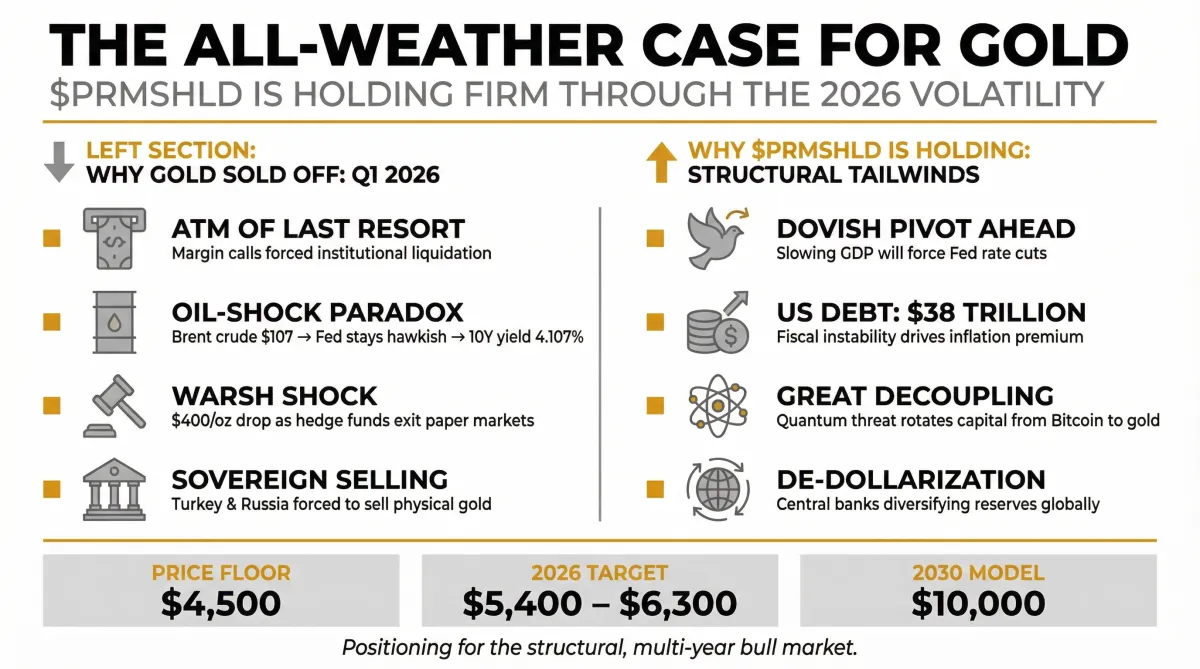
The "ATM of Last Resort" Dynamic: During extreme market volatility in equities and oil, institutional investors faced massive portfolio stress and margin calls. Gold is highly liquid, which paradoxically turned it into an "ATM of last resort," forcing institutions to violently liquidate their bullion positions to cover losses elsewhere.
The "Oil-Shock Paradox" & Real Yields: When Brent crude spiked past $107 per barrel due to disruptions in the Strait of Hormuz, the Federal Reserve viewed this energy inflation as a massive threat. Instead of cutting rates as the market expected, the Fed pivoted to a "higher-for-longer" monetary stance. This drove the 10-year U.S. Treasury yield up to 4.107%. Because gold yields nothing, surging real interest rates and a newly minted "Super-Haven" U.S. dollar siphoned capital away from metals.
The "Warsh Shock" in Paper Markets: The nomination of monetary strictness advocate Kevin Warsh as Federal Reserve Chair caused speculative hedge funds to rapidly exit the paper market, driving a massive $400-per-ounce drop in late January.
Emergency Sovereign Selling: The energy shock put severe macroeconomic pressure on several nations, forcing central banks like Turkey (to defend the Lira) and Russia (to fund military deficits) to become involuntary sellers of physical gold.
The Tailwinds: Why Gold is Compelling Today
Historical precedents, such as the 2008 financial crisis and the 2020 pandemic, demonstrate that this "panic phase" sell-off is a normal part of market plumbing before a new bull run begins. Wall Street analysts view this as a strategic accumulation opportunity rather than a trend reversal.
For the $PRMSHLD portfolio, these are the deep-seated structural tailwinds that keep our metals allocation anchored:
Looming Dovish Pivot: The hawkish stance that rattled markets in early 2026 is unlikely to last forever. A slowing U.S. economy and downward revisions in GDP will eventually force the Federal Reserve to abandon its "higher-for-longer" policy, providing a massive runway for gold.
Historic Debt and Fiscal Instability: With the U.S. national debt sitting at a staggering $38 trillion, continuous government deficits guarantee that an "inflation premium" will remain a primary driver for precious metals as investors hedge against fiat debasement.
The "Great Decoupling" & Quantum Threat: Capital is actively rotating out of digital alternative assets like Bitcoin due to the rising "Quantum Threat"—fears that quantum computing could soon break blockchain security. As a completely physical asset with zero technological risk, gold is being structurally revalued as the ultimate "geopolitical shock absorber".
Unstoppable De-Dollarization: Despite isolated emergency sales by a few nations, the broader global shift toward a multi-polar financial system and central bank reserve diversification remains heavily intact, ensuring persistent official sector demand.
The Long-Term Outlook for $PRMSHLD
Ultimately, gold's modern price trajectory is heavily dominated by macroeconomic expectations. As the global financial system adapts to ongoing fiscal stress and geopolitical fragmentation, gold is projected to reaffirm its position as the premier refuge and a fundamental strategic asset.
Conservative institutional forecasts establish a strong price floor around $4,500, with end-of-2026 projections targeting a rebound between $5,400 and $6,300 per ounce. Aggressive long-term models even suggest gold could hit $10,000 by 2030.
This is exactly why the All-Weather $PRMSHLD portfolio maintains its position. We are looking past the short-term liquidity panic and positioning ourselves for the structural, multi-year bull market that is just getting started.