
Navigating the Private Credit Storm: Why I'm Increasing Cash Exposure in the $PRMSHLD Portfolio
The financial landscape is navigating a precarious inflection point. What I believe to be the early stages of a "run on the bank" has already begun — not in the traditional banking system, but within the sprawling, opaque world of private credit. Across the industry, major private credit originators are hitting their maximum quarterly redemption limits. As a result, billions of dollars of investor capital are currently trapped behind withdrawal gates, exposing the structural vulnerabilities of this 2 trillion dollar market in real time.
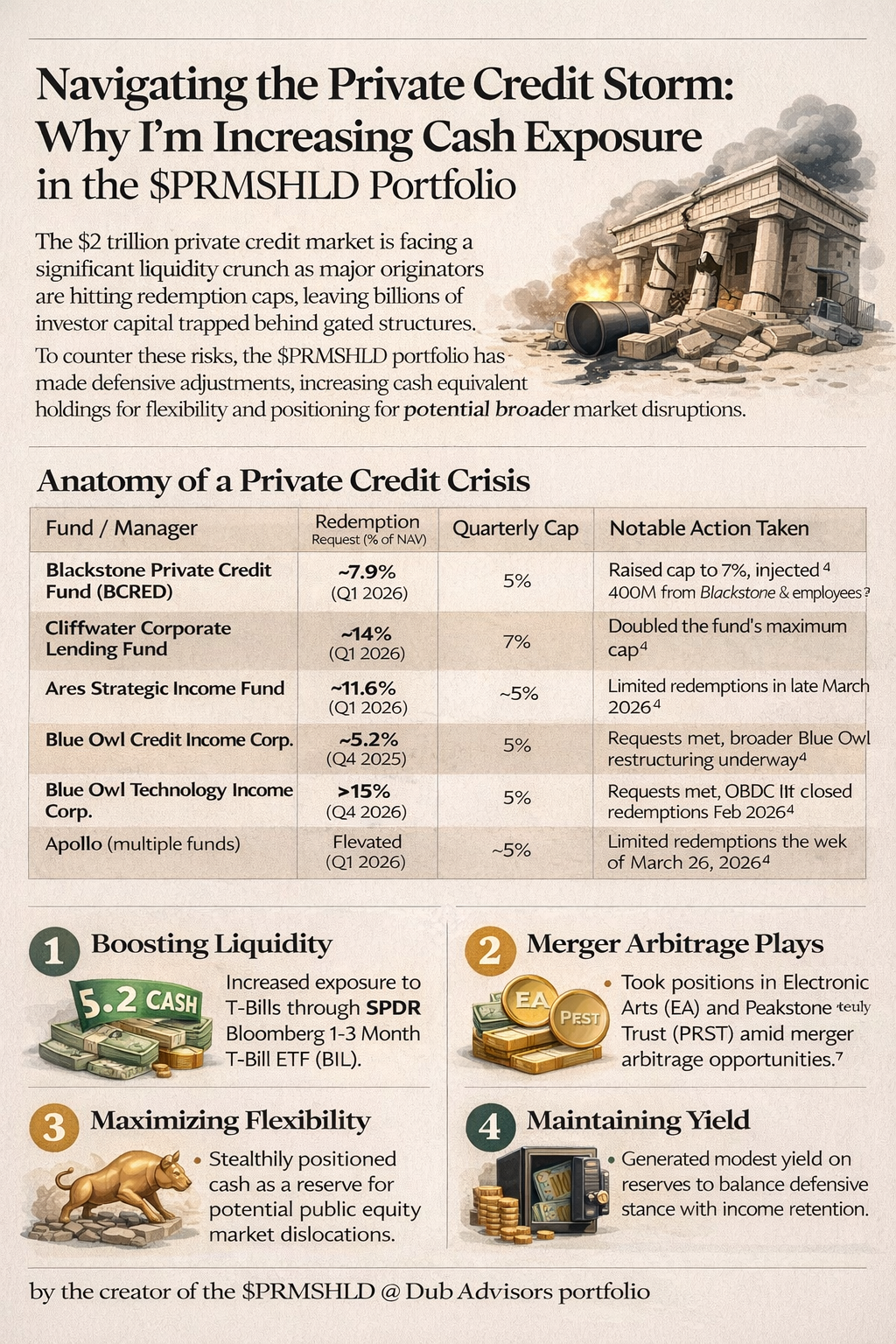
In response to these escalating risks, I have made deliberate defensive adjustments to the PRMSHLD portfolio. First, I am increasing our cash equivalent holdings through the SPDR Bloomberg 1-3 Month T-Bill ETF (BIL). Second, I have established positions in Electronic Arts (EA) and Peakstone Realty Trust (PKST) as merger arbitrage plays. Together, these moves are designed to preserve capital, generate a modest yield on our reserves, and ensure we hold meaningful "dry powder" to deploy if this crisis exacerbates and spills into the broader public equity markets.
I. The Anatomy of a Private Credit Crisis
The Market's Structural Promise — and Its Flaw
The private credit industry has grown at a remarkable pace, expanding fourfold since 2014 to surpass $2 trillion in assets under management, with projections suggesting it could approach $4 trillion by 2030 [1]. The growth was fueled by a compelling value proposition: institutional investors could access higher-yielding private loans — typically extended to middle-market companies — while asset managers offered a degree of periodic liquidity through semi-liquid fund structures such as non-traded Business Development Companies (BDCs), interval funds, and non-traded REITs.
The standard architecture of these vehicles includes quarterly redemption windows, typically capped at 5% of Net Asset Value (NAV) per quarter [2]. This design was intended to balance the illiquid nature of the underlying loan portfolios with investor demand for some degree of flexibility. In practice, however, this structure contains a fundamental flaw: it offers the appearance of liquidity while the underlying assets remain deeply illiquid. As one analysis aptly noted, liquidity in these funds is largely a "fair-weather feature," contingent on steady capital inflows, calm markets, and functioning short-term credit lines [3]. The moment investor confidence wavers, the incentive to redeem early becomes overwhelming — and the system begins to buckle.
The Redemption Wave: A Cascade of Gate Triggers
Beginning in late 2024 and accelerating sharply through the first quarter of 2026, a wave of redemption requests has swept through the private credit industry, consistently exceeding the quarterly caps that were supposed to manage orderly exits. The aggregate scale of the problem is striking: across more than a dozen funds, total withdrawal requests in Q1 2026 reached approximately 13 billion dollars, yet investors were only able to access roughly two-thirds of that capital due to redemption limits — leaving over 4.6 billion dollars of capital effectively trapped [4].
The following table summarizes the most significant redemption events among major private credit originators:
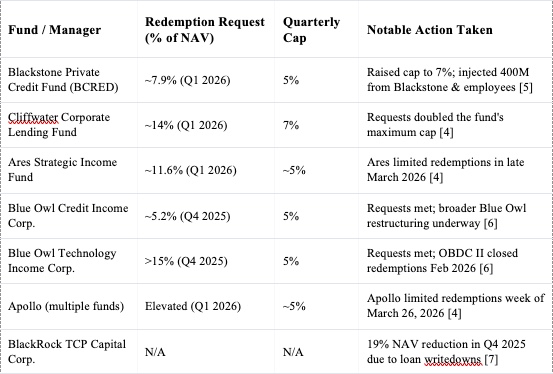
The breadth of this phenomenon is not limited to individual fund failures. For the non-listed BDC sector as a whole, redemptions as a share of beginning-of-quarter NAV nearly tripled in Q4 2025, reaching 4.71%. For BDCs with over 1 billion dollars in NAV, redemptions surged by 217% quarter-over-quarter [8]. This is not noise — it is a structural shift in investor sentiment.
The Self-Reinforcing Loop
What makes this situation particularly dangerous is its self-reinforcing character. Boaz Weinstein, a prominent credit investor, has warned of a "reflexivity of falling NAVs, leading to larger outflows, leading to forced selling, leading to falling NAVs" [3]. This is precisely the dynamic we are observing. When a fund cannot honor redemption requests in full, it signals to remaining investors that their own exit may be delayed or impaired. This perception accelerates the queue of withdrawal requests, forcing fund managers to either draw on credit lines, sell portfolio assets at distressed prices, or both. Each of these responses further erodes NAV, validating the fears that drove the initial redemptions.
Blue Owl Capital's trajectory illustrates this vividly. Following an unsuccessful attempt to merge two of its entities in fall 2025, the firm's stock declined nearly 60% by late March 2026 [6]. The failed merger rattled investor confidence, accelerated redemptions across its fund family, and ultimately forced the firm to close quarterly redemptions on OBDC II in February 2026 — a significant capitulation for a firm that had positioned these vehicles as accessible private market solutions [6].
II. Why This Could Crack the Broader System
The Banking System's Hidden Exposure
The private credit crisis does not exist in a vacuum. Its tentacles reach into the conventional banking system in ways that are not immediately visible but are deeply concerning. A May 2025 report from the Federal Reserve revealed that committed credit lines from the largest U.S. banks to private credit vehicles — including private debt funds and BDCs — surged by approximately 145% over the preceding five years, reaching 95 billion dollars by Q4 2024 [9]. Critically, the utilization rate on these lines stood at 56%, with 44 billion dollars already drawn. Sixty percent of these commitments are concentrated among just five Global Systemically Important Banks (G-SIBs) [9].
This creates a direct transmission channel: if private credit funds face a severe liquidity crunch and are forced to draw heavily on these bank credit lines simultaneously, the resulting strain on bank balance sheets could restrict broader credit availability across the economy. The scenario is not hypothetical — it is the logical extension of the redemption dynamics already underway.
Fire Sales and Public Market Contagion
The second contagion pathway runs through asset prices. When private credit funds are forced to liquidate holdings to meet redemption requests, they must sell into markets that may already be under stress. These forced sales can depress prices in the leveraged loan and high-yield bond markets, tightening financial conditions for a broad range of corporate borrowers. The resulting credit contraction can then flow through to public equity valuations, particularly for companies that rely on leveraged financing — a large swath of the mid-cap and small-cap universe.
This mechanism draws historical parallels to the 2008 financial crisis, where the forced unwinding of mortgage-backed securities created cascading price declines across asset classes that had previously appeared uncorrelated. The private credit market, with its reliance on securitization structures and its interconnectedness with CLOs (Collateralized Loan Obligations), faces analogous risks if a disorderly unwind begins [10].
Deteriorating Loan Quality
Compounding the liquidity risk is a deteriorating credit quality picture within the underlying loan portfolios. Fitch Ratings reported that the U.S. private credit default rate within its Privately Monitored Ratings portfolio rose to 9.2% in 2025, more than double the 4.5% default rate recorded for broadly syndicated loans in the same period [11]. Proskauer's Private Credit Default Index showed a Q4 2025 default rate of 2.46%, up from 1.76% just two quarters earlier [12].
Moody's downgraded FS KKR Capital Corp. to junk status in March 2026, citing asset quality challenges, weaker profitability, and NAV erosion [13]. The firm's non-accrual loans — loans on which interest is no longer being collected — climbed to 5.5% of total investments by year-end 2025, one of the highest levels among rated BDCs [13]. UBS has projected that under an "aggressive disruption" scenario involving accelerated AI adoption, private credit default rates could surge to 13% in 2026, more than triple the stress scenario projected for high-yield bonds [13].
To understand the gravity of these projections, we must look to history. The 2008 financial crisis began to unravel when subprime mortgage default rates reached approximately 14% [14]. While the private credit market is structurally different from the residential mortgage market of 2008, the analogy is striking. A 13% to 14% default rate is not merely a sign of stress; history suggests it is the threshold where localized distress cascades into systemic disruption. If private credit defaults approach these historical danger zones, the resulting credit contraction could severely impact the broader economy.
The proliferation of Payment-in-Kind (PIK) loans — structures that allow borrowers to defer cash interest payments by adding the interest to the principal balance — is a particularly insidious risk factor. PIK loans can mask the true financial health of borrowers, allowing funds to report performing loans that are, in substance, quietly deteriorating. When these borrowers eventually face a liquidity event, the losses can be sudden and severe.
III. Portfolio Positioning: Building the Defense
Given the risks outlined above, my approach for the PRMSHLD portfolio is to prioritize capital preservation and liquidity while maintaining the optionality to deploy capital aggressively when the opportunity presents itself. This is achieved through two complementary strategies.
Strategy 1 — Dry Powder via BIL
The first and most direct response to the current environment is to increase our cash equivalent holdings. Rather than holding idle cash in a brokerage account at near-zero yield, I have established a meaningful position in the SPDR Bloomberg 1-3 Month T-Bill ETF (BIL).
BIL tracks the Bloomberg 1-3 Month U.S. Treasury Bill Index, holding a diversified portfolio of 23 Treasury Bills with an average maturity of approximately 0.13 years [14]. The fund's characteristics make it the ideal instrument for this purpose:
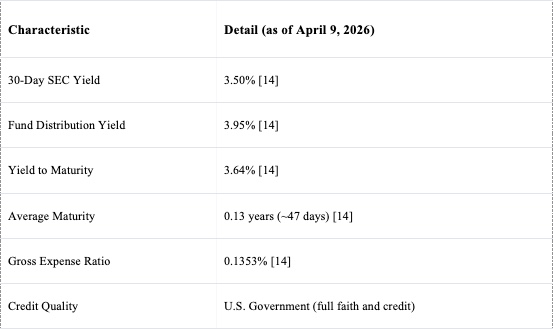
The strategic rationale is straightforward. BIL allows us to earn a competitive yield — approximately 3.50% on a 30-day SEC basis — while maintaining the ability to liquidate the position at any time with minimal price risk. Unlike longer-duration bond funds, BIL's ultra-short maturity profile means it is virtually immune to interest rate movements. It is, in essence, cash that works for us while we wait.
This approach is consistent with the philosophy employed by some of the most disciplined capital allocators in history. Warren Buffett, for instance, has famously maintained substantial T-bill holdings as a reserve of optionality — capital that earns a modest return but is always available to be deployed into exceptional opportunities [15]. In the current environment, where I believe the risk of a broader market dislocation is elevated, this dry powder reserve is not a drag on performance — it is a strategic asset.
Strategy 2 — Merger Arbitrage via EA and PKST
The second pillar of our defensive positioning is the use of merger arbitrage on announced acquisitions. This strategy allows us to maintain equity market exposure while significantly reducing our vulnerability to broad market declines. I have established positions in two such opportunities: Electronic Arts (EA) and Peakstone Realty Trust (PKST). Combined, these two positions represent over 15% of the portfolio (7.81% in EA and 7.76% in PKST).
Electronic Arts (EA): On September 29, 2025, EA announced it had agreed to be acquired by a consortium comprising Saudi Arabia's Public Investment Fund (PIF), Silver Lake, and Affinity Partners in an all-cash transaction valued at approximately 55 billion dollars [16]. The deal is expected to close by June 2026, subject to customary regulatory approvals [16].
Peakstone Realty Trust (PKST): On February 2, 2026, Brookfield Asset Management announced a definitive agreement to acquire PKST in an all-cash transaction valued at approximately 1.2 billion dollars. Brookfield is acquiring all outstanding shares for 21.00 dollars per share in cash, with the deal expected to close by the end of the second quarter of 2026 [17]. The transaction received unanimous board approval, and the "go-shop" period expired in early March without a superior proposal [17].
The mechanics of merger arbitrage are well-established. Once an all-cash acquisition is announced, the target company's stock price typically trades at a modest discount to the announced deal price, reflecting the residual risk that the deal may not close. By purchasing shares of EA and PKST at this discounted level, we are effectively locking in a defined return — the spread between our purchase price and the deal price — provided the acquisitions complete as announced.
Critically, this strategy provides downside protection in a way that holding a typical equity position does not. If the broader market declines due to contagion from the private credit crisis, the stock prices of EA and PKST are anchored by their respective announced acquisition prices. The deal terms act as a floor, insulating this 15%+ portion of the portfolio from the macro-driven volatility that might otherwise erode equity valuations across the board. This is not a bet on the underlying businesses of EA or PKST — it is a bet on the deals closing, which is a much more bounded and analyzable risk.
IV. The Bigger Picture: Positioning for the Opportunity Ahead
The strategy outlined above is inherently defensive, but it is defense in service of offense. The private credit crisis, if it continues to escalate, has the potential to create the kind of broad-based market dislocation that generates exceptional buying opportunities for investors who have preserved capital and maintained liquidity. History is instructive here: the investors who were best positioned to capitalize on the dislocations of 2008-2009, 2020, and other periods of acute stress were those who had the discipline to hold cash and the patience to wait for the right moment.
The PRMSHLD portfolio is being positioned with exactly this philosophy in mind. By holding BIL as our dry powder reserve and using merger arbitrage to generate stable, anchored returns on a portion of our equity exposure, we are building a portfolio that can absorb shocks while remaining ready to act. If the private credit crisis remains contained, we will have sacrificed some upside — a cost I am willing to accept. If it exacerbates and spreads into the public markets, we will be among the best-positioned investors to capitalize on the resulting dislocations.
The storm in private credit has already begun. The question is not whether it will have consequences — it is how far those consequences will reach.
This article reflects the personal views and portfolio positioning of the creator of the $PRMSHLD @ DubAdvisors portfolio. It does not constitute financial advice, and the author does not represent or speak on behalf of DubAdvisors. All investments involve risk, including the potential loss of principal.
References
[1]: Moody's, "Private Credit 2026 Outlook", 2026.
[2]: WealthManagement.com,"Private Credit Confronts the Limitations of the Semi-Liquid Label", 2026.
[3]: Accredited Insight,"When Gates Shut Close: A Primer On Redemption Gates in Private Credit", 2026.
[4]: AdvisorHub,"Trapped in Private Credit: Investors Wait to Pull Out $5 Billion", 2026.
[5]: Reuters,"BlackRock Limits Withdrawals as Private Credit Fund Redemptions Mount", March 2026.
[6]: The Guardian,"Blue Owl Capital Private Credit Investment Limits Withdrawals", April 2026.
[7]: Forbes,"Private Credit Under Pressure: Defaults, Redemptions, and the AI Shock", March 2026.
[8]: AltsWire,"Emerging BDC Redemption Trends Echo Earlier Non-Traded REIT Liquidity Cycle", 2026.
[9]: Federal Reserve,"Bank Lending to Private Credit: Size, Characteristics, and Financial Stability Implications", May 2025.
[10]: Harvard Kennedy School,"Private Credit Systemic Risk", 2025.
[11]: Fitch Ratings,"U.S. Private Credit Defaults Ease to 5.4% in February 2026", March 2026.
[12]: Proskauer,"Proskauer's Private Credit Default Index Reveals Rate of 2.46% for Q4 2025", 2026.
[13]: AOL Finance / Moody's,"Moody's Warning on Private Credit", March 2026.
[14]: National Bureau of Economic Research (NBER),"Did Bankruptcy Reform Cause Mortgage Default to Rise?", and Federal Reserve History.
[15]: State Street Global Advisors,"SPDR Bloomberg 1-3 Month T-Bill ETF (BIL)", April 2026.
[16]: Electronic Arts Investor Relations,"EA Announces Agreement to be Acquired by PIF, Silver Lake, and Affinity Partners for $55 Billion", September 2025.
[17]: Peakstone Realty Trust Investor Relations,"Brookfield to Acquire Peakstone Realty Trust in a $1.2 Billion All-Cash Transaction", February 2026.